The State of Leadership Accountability
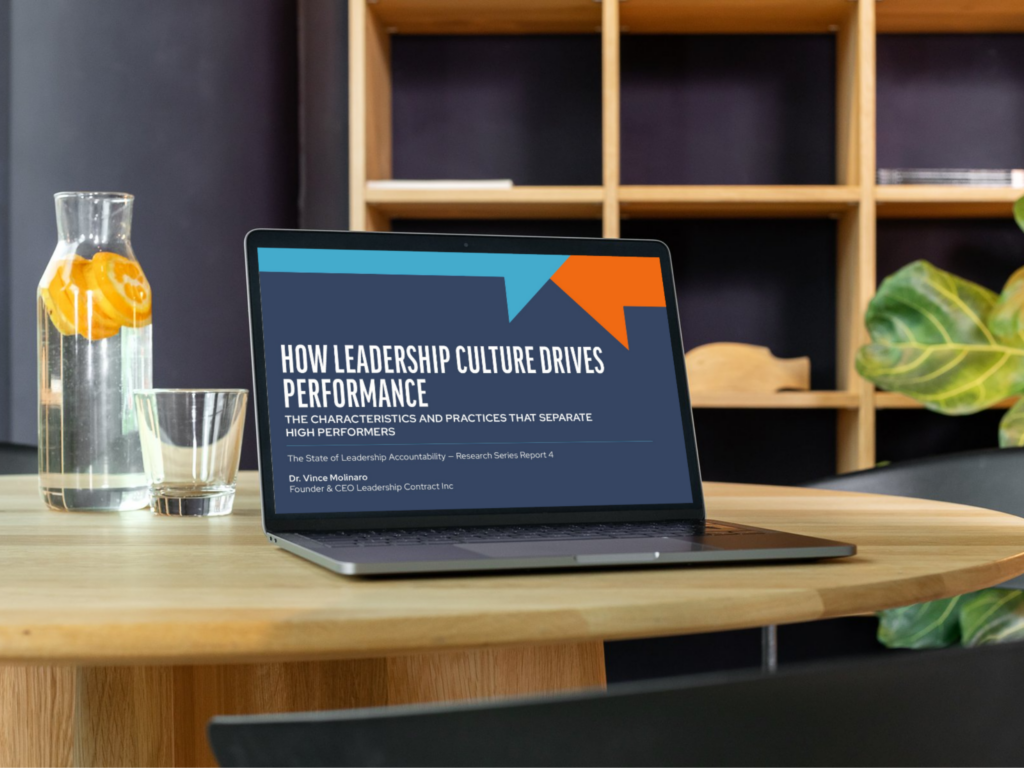
How Leadership Culture Drives Performance
Our fourth research report on The State of Leadership Accountability reveals the characteristics and practices that separate high performers.
A practical, research-backed blueprint to strengthen execution, alignment, and accountability across your leadership community.
Leadership culture is one of the most underleveraged sources of performance advantage. Our research found a clear pattern: organizations that build a strong leadership culture and act as a community of leaders consistently outperform those that do not.
This report reveals what high performers do differently, the barriers that stall leadership culture change, and the organizational practices that build strong leadership cultures, especially during strategic change.
What you will find in this report:
Executive summary
- A clear overview of what the research set out to understand about leadership culture and performance, what the data revealed, and why it matters now.
Why building a strong community of leaders is now a business imperative
- Why leadership culture has become more critical in today’s environment of complexity and ambiguity, and why execution now depends on leaders working together across functions, regions, and business units.
The Findings
- Belief vs reality
- The 10 characteristics of a community of leaders by company performance
- The barriers to leadership culture change
- The organizational practices that build strong leadership cultures
Implications for senior executives and organizations
- Why leadership culture is fundamentally about strategy execution, and why fragmented leadership cultures quietly slow decisions, erode accountability, and create friction over time.
- The four big takeaways leThe role of the C-suite reframed: senior leaders must act as architects of the system that makes strong leadership the default through clarity, reinforcement, and support.
Conclusion
- The bottom line: leadership culture remains one of the most underleveraged sources of performance advantage, especially during strategic shifts.
Key Findings: the Four Big Takeaways
1) A strong leadership culture is a performance differentiator
High-performing organizations are consistently stronger across the leadership traits that matter most under pressure.
2) High performers operate as a community of leaders
They align on priorities, collaborate across departments, and hold one another accountable.
3) Leadership constraints are the biggest barrier to culture change
The most significant blockers are leaders feeling overwhelmed, uneven commitment, resistance, and misalignment.
4) Strong leadership cultures are built through disciplined organizational practices
Nine practices form a Leadership Accountability System that creates clarity, alignment, and shared accountability.
See the impact of our research